When you climb a mountain, the temperature usually drops as you gain elevation. Snow may cover the summit even when the valleys below are warm and sunny. This seems strange at first because the top of a mountain is technically closer to the Sun than the land at sea level.
If being closer to the Sun makes something warmer, why are mountain peaks so cold?
The answer lies in how the Sun heats the Earth, how the atmosphere behaves, and how air pressure changes with altitude. Mountains are colder not because they receive less sunlight in every situation, but because the air at higher elevations is generally less dense and cools as it expands.
Understanding this process reveals an important principle about the Earth’s atmosphere and explains why temperatures can vary dramatically over relatively short distances.
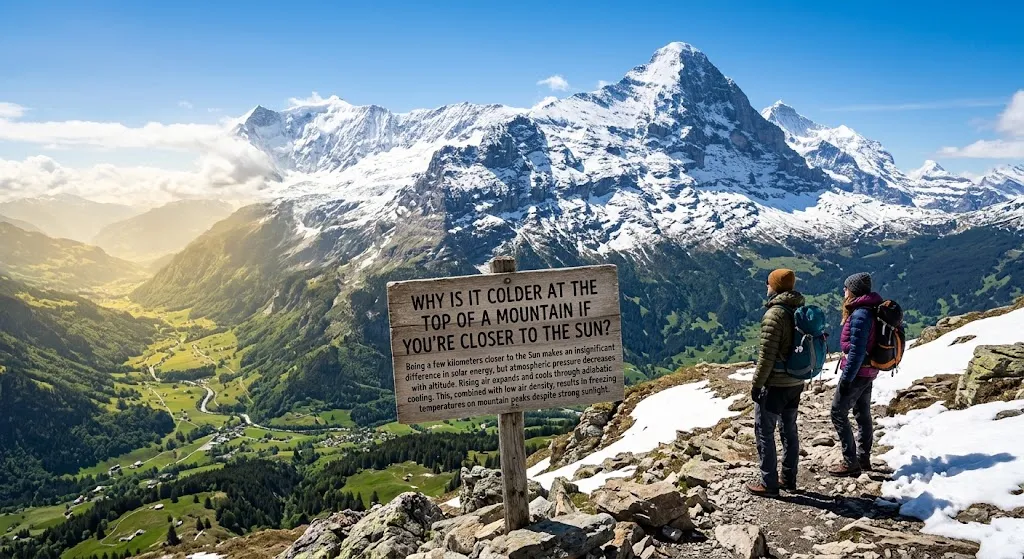
Does Being Closer to the Sun Make a Mountain Warmer?
The difference in distance between a mountain summit and sea level is tiny compared with the enormous distance between Earth and the Sun.
The average distance from Earth to the Sun is approximately 150 million kilometers. Even a mountain that rises 5 kilometers above sea level brings its summit only 5 kilometers closer to the Sun.
Compared with 150 million kilometers, that difference is practically insignificant. A mountain’s elevation changes its distance from the Sun by only a tiny fraction of one percent.
For example, if you climbed a mountain several kilometers high, you would be slightly closer to the Sun, but the additional solar energy reaching you would be negligible compared with the effects of atmospheric conditions.
The key point is that the Sun does not primarily heat the air directly in the way a fire heats the space immediately around it. Instead, sunlight passes through much of the atmosphere and warms the Earth’s surface. The surface then transfers energy to the air through infrared radiation, conduction, and convection.
Because mountain air behaves differently from air near the ground, the temperature generally decreases with altitude.
How Does the Sun Actually Heat the Earth?
To understand why mountain peaks are cold, it helps to examine the process by which our planet receives and distributes heat.
1. Sunlight passes through the atmosphere
Solar radiation travels through space and enters Earth’s atmosphere. Much of this energy reaches the surface, although clouds, atmospheric gases, dust, and other particles reflect or absorb some of it along the way.
2. The Earth’s surface absorbs energy
Land, oceans, rocks, forests, and other surfaces absorb sunlight and become warmer. Different surfaces absorb and release heat at different rates, which is why deserts, forests, and oceans can have very different temperatures.
3. The warmed surface heats the air
The ground transfers energy to the air in contact with it. Warm air can then rise, carrying energy into the atmosphere.
The atmosphere also absorbs some infrared radiation emitted by the surface, particularly through greenhouse gases such as water vapor and carbon dioxide.
4. The atmosphere becomes cooler at higher elevations
In the lowest layer of the atmosphere, called the troposphere, air pressure decreases with altitude. As air rises into regions of lower pressure, it expands. This expansion requires energy, and when the air does not receive enough heat from its surroundings, its temperature falls.
This process, known as adiabatic cooling, is one of the main reasons the air is generally colder near mountain summits.
What Is Adiabatic Cooling?
Adiabatic cooling is the cooling of a gas as it expands without gaining enough heat from its surroundings to offset the energy involved in that expansion.
It is an essential concept in meteorology because it explains how rising air cools and how clouds, rain, and snow can form.
Imagine a parcel of air near the ground. Atmospheric pressure is relatively high because a large column of air lies above it. When the parcel rises, the surrounding pressure becomes lower.
The air parcel expands to adjust to the lower pressure. During this expansion, it does work on its surroundings, and its internal energy decreases. As a result, its temperature falls.
This does not mean that the air loses heat to a cold mountain surface in every case. Instead, its temperature decreases as a consequence of expansion.
Why does this matter on a mountain?
As air moves upward along a mountain slope, it encounters lower atmospheric pressure. The rising air expands and cools, which can contribute to lower temperatures, cloud formation, and precipitation.
The cooling rate depends on whether the air is dry or contains enough water vapor to form clouds.
- Dry air: Rising unsaturated air typically cools at approximately 9.8°C per kilometer.
- Moist air: Rising saturated air generally cools more slowly because condensation releases latent heat. The rate varies with temperature and moisture content.
These values are approximate. Actual mountain temperatures depend on humidity, wind, sunlight, cloud cover, and local geography.
How Much Colder Does It Get as You Climb?
Temperature generally decreases with altitude in the troposphere, but the exact rate varies from one location and weather situation to another.
A useful reference is the average environmental lapse rate, which is approximately 6.5°C per kilometer in the lower atmosphere.
This means that, under average conditions, the air temperature may decrease by about 6.5°C for every 1,000 meters of elevation gained.
Consider a simplified example:
| Elevation | Illustrative air temperature |
|---|---|
| Sea level | 25°C |
| 1,000 meters | 18.5°C |
| 2,000 meters | 12°C |
| 3,000 meters | 5.5°C |
| 4,000 meters | -1°C |
These figures demonstrate the general relationship between elevation and temperature. They are not a weather forecast, and actual temperatures can differ considerably.
For instance, a sunny mountain slope may be warmer than expected, while a shaded valley may remain cold. Strong winds can also make a summit feel much colder than the measured air temperature.
Nevertheless, the general pattern explains why mountain peaks can experience freezing conditions even when the surrounding lowlands are comfortably warm.
Why Is the Air Pressure Lower on a Mountain?
Air pressure is the force exerted by the weight of the atmosphere above a particular location.
At sea level, a person has an entire column of atmosphere above them. At the top of a mountain, a smaller amount of air lies overhead.
Because there is less air above the summit, the atmospheric pressure is lower.
Lower pressure affects temperature by allowing rising air to expand more easily. As the air expands, its temperature decreases unless energy enters the air parcel in sufficient quantities to compensate.
This relationship also explains why breathing becomes more difficult at high elevations. The percentage of oxygen in the atmosphere remains approximately the same, but the lower air pressure means that each breath delivers fewer oxygen molecules.
The effects can become noticeable at high altitudes, especially during strenuous physical activity.
Why Are Mountain Peaks Often Covered in Snow?
Cold temperatures are a major reason snow remains on high mountain peaks, but several other factors contribute to the phenomenon.
Lower temperatures allow snow to survive
Snow can accumulate when temperatures are low enough for precipitation to fall as snow and for existing snow to melt slowly or not at all.
Even when the valleys are warm, mountain summits may remain below freezing.
Mountains influence precipitation
When moist air encounters a mountain range, it is often forced upward. As the air rises, it expands and cools. If it reaches saturation, water vapor condenses into clouds and may produce rain or snow.
This process is called orographic lifting.
The windward side of a mountain may therefore receive substantial precipitation, while the leeward side can be much drier because descending air warms and becomes less humid.
Snow reflects sunlight
Snow has a high albedo, meaning it reflects a large proportion of incoming sunlight. This reduces the amount of solar energy absorbed by the surface and helps snow remain in place.
However, snow does not automatically survive throughout the year. Strong sunlight, warmer air, rain, and changes in seasonal conditions can melt it, even at high elevations.
The combination of lower temperatures, precipitation patterns, and snow’s reflective properties helps explain why some mountain peaks remain snow-covered year-round.
Does the Sun Shine More Strongly at High Altitudes?
In some circumstances, yes. This is another reason the relationship between mountain elevation and temperature can seem confusing.
At high elevations, sunlight passes through a smaller amount of atmosphere before reaching the surface. As a result, less solar radiation may be scattered or absorbed along its path.
Under clear conditions, ultraviolet radiation exposure can also increase with altitude. Snow can intensify exposure by reflecting ultraviolet radiation toward the body.
However, stronger sunlight does not necessarily mean that the surrounding air will be warmer.
Air temperature depends on several factors, including the energy absorbed by the ground, the movement of air, atmospheric pressure, humidity, clouds, and heat exchange with the surroundings.
A mountain summit can receive intense sunshine while remaining below freezing because the thin air and atmospheric conditions favor lower temperatures.
This is why hikers can experience a combination of bright sunlight, cold air, and strong winds at high elevations.
Why Can a Mountain Be Cold During the Day but Warm in the Sun?
The temperature of the air and the temperature of an object exposed to sunlight are not always the same.
A dark rock in direct sunlight can become much warmer than the surrounding air because it absorbs solar radiation. A person standing beside the rock may feel warmth from the Sun even when the air temperature is close to freezing.
When the Sun disappears behind a cloud or sets below the horizon, the rock receives less energy and begins to cool.
Mountain environments can experience rapid changes in temperature because of their exposure to sunlight, strong winds, and relatively dry air. At night, the ground loses energy through infrared radiation, and temperatures can fall quickly, particularly under clear skies.
Cloud cover can reduce nighttime cooling by absorbing and re-emitting infrared radiation, although its effects depend on the local weather.
Consequently, a sunny mountain afternoon can feel comfortable while the same location becomes dangerously cold after sunset.
Are All Mountains Colder Than the Land Below Them?
Not always. Although temperatures generally decrease with altitude in the troposphere, local weather conditions can produce exceptions.
One example is a temperature inversion.
Under normal conditions, the air is often warmer near the ground and colder at higher elevations. During an inversion, a layer of warmer air sits above colder air near the surface.
Inversions commonly occur during calm, clear weather when the ground loses heat overnight. Cold, dense air can collect in valleys while warmer air remains above it.
As a result, a mountain slope or summit may be warmer than a nearby valley.
This is why people sometimes observe fog and freezing conditions in low-lying areas while the hills above them are sunny and relatively mild.
Other factors, such as wind direction, cloud cover, slope orientation, and differences in surface heating, can also influence local temperatures.
The relationship between altitude and temperature is therefore a general atmospheric pattern rather than an absolute rule.
Why Does Temperature Decrease in the Troposphere but Not Everywhere in the Atmosphere?
The troposphere is the lowest layer of Earth’s atmosphere and contains most of its water vapor and weather systems.
In this layer, temperature generally decreases with altitude because the atmosphere is heated largely from below, and rising air expands as pressure decreases.
Above the troposphere lies the stratosphere, where the temperature pattern changes. Ozone absorbs ultraviolet radiation from the Sun, warming the upper portions of this atmospheric layer.
This means that temperature does not decrease continuously throughout the entire atmosphere.
The distinction is important because the explanation for cold mountain summits applies primarily to conditions in the troposphere, where most mountains are located.
Frequently Asked Questions
Why is it colder on a mountain if it is closer to the Sun?
The difference in distance to the Sun is negligible compared with the Sun’s distance from Earth. Mountain air is generally colder because atmospheric pressure decreases with altitude, allowing rising air to expand and cool.
How many degrees does temperature drop for every 1,000 meters?
The average environmental temperature lapse rate is approximately 6.5°C per 1,000 meters in the troposphere. The actual rate varies with weather conditions, humidity, and location.
Is the Sun stronger at higher elevations?
Direct sunlight and ultraviolet exposure can be stronger at high elevations because the atmosphere absorbs and scatters some radiation before it reaches the surface. Nevertheless, the air can remain cold because sunlight intensity and air temperature are different things.
Why does snow remain on mountain peaks?
Snow persists when temperatures and seasonal conditions allow accumulation to exceed melting. High elevations often experience colder air, and snow reflects much of the incoming sunlight, helping limit surface warming.
Can a mountain summit be warmer than a valley?
Yes. During a temperature inversion, cold air can settle in valleys while warmer air remains above it. Under these conditions, a mountain slope or summit can be warmer than the surrounding lowlands.
Does low air pressure directly make air cold?
Low pressure alone does not automatically make air cold. The key process is that air rising into lower pressure expands and cools when it does not receive enough heat to compensate for the energy involved in expansion.
Conclusion
The reason mountain peaks are colder despite being closer to the Sun is a fascinating example of how Earth’s atmosphere works.
The difference in distance to the Sun is far too small to make a meaningful difference in the amount of solar energy received. Instead, temperature decreases with elevation largely because atmospheric pressure falls with altitude, causing rising air to expand and cool.
This process, combined with precipitation, sunlight, wind, and local geography, explains why snow can cover a mountain summit while the valley below remains warm.
Ultimately, being closer to the Sun does not determine how warm a place will be. What matters is how solar energy is absorbed, transferred, and distributed through the Earth’s surface and atmosphere.