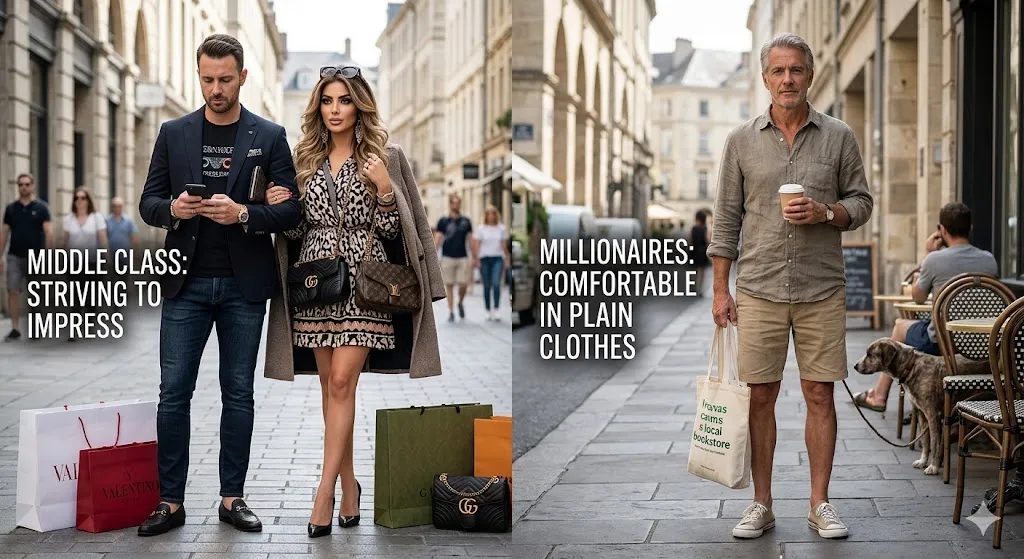
Middle-class consumers often spend more visibly on luxury goods than actual millionaires because of status anxiety, social comparison, and aspirational identity signaling. Truly wealthy people tend to prioritize long-term wealth accumulation over outward displays of status.
There is a peculiar irony hiding in plain sight at every shopping mall, car dealership, and Instagram feed in the modern world. The people most aggressively broadcasting wealth through designer logos, leased luxury cars, and carefully curated lifestyles are, statistically speaking, not the wealthiest people in the room. The truly wealthy — the quietly rich, the old-money families, the self-made millionaires who built fortunes over decades — are often the ones in the unbranded sneakers, the decade-old sedan, and the modest house with the unremarkable lawn.
This is not an accident. It is a deeply ingrained psychological and sociological phenomenon, and once you understand it, you will never look at a luxury brand the same way again.
The gap between looking wealthy and being wealthy is wider than most people realize. To understand why middle-class people often try harder to signal affluence than actual millionaires, we need to explore the psychology of status anxiety, the economics of aspiration, the sociology of class identity, and the counterintuitive habits of the genuinely rich.
The Status Anxiety That Fuels Everything
Philosopher Alain de Botton wrote extensively about status anxiety — the nagging, persistent fear that we are not good enough, successful enough, or admired enough in the eyes of others. This anxiety is not equally distributed across economic classes. It tends to peak among people who are in transition — those who have climbed above poverty but have not yet reached true financial security, or those who exist in that vast and complicated middle ground where comfort and vulnerability coexist uneasily.
For people in this zone, money is still a fresh and fragile thing. They grew up watching it disappear. They know what it feels like to worry about rent, to skip a vacation, to feel the sting of economic exclusion. Now that they have some financial breathing room, there is a powerful psychological urge to prove it — to themselves and to everyone around them. The luxury handbag, the German car, the expensive watch are not just objects. They are evidence. They are a declaration to the world: I made it. I am not what I was.
This is a deeply human response. We are social creatures wired for hierarchy, and for most of human history, status had immediate survival implications. Being seen as high-status meant better access to resources, mates, protection, and social capital. The brain does not easily distinguish between the ancient savanna and a modern suburb — status signals still trigger powerful emotional responses.
Millionaires, by contrast, often have already resolved this anxiety. Once wealth reaches a certain level of security and self-sufficiency, the urgent need to broadcast it tends to dissolve. Their identity is no longer threatened by other people’s perceptions.
The Economics of Aspiration: Buying Identity, Not Utility
The luxury goods industry understands one thing above all else: their biggest customers are not the ultra-wealthy, they are the aspirational middle class. Industry analysts have long known that the volume of luxury sales is driven not by the top one percent but by people who stretch their budgets to access the brand’s symbolic value. A bag that costs two months of a middle-income professional’s salary is not a rational economic decision — it is an identity purchase.
Wealthy people, on the other hand, have access to a different kind of luxury: quality without logos. The truly rich do not need a brand to validate a purchase. They can spend lavishly on things that are invisible to others — the handmade suit with no visible label, the private vacation home in an unmarked location, the watch that is extraordinarily expensive but looks almost ordinary to the untrained eye. This is sometimes called “stealth wealth” — the preference for quality legible only to those already in the know.
The middle class, lacking this insider access and social fluency, relies on broadly recognizable signals — logos, brand names, famous models — because these communicate status instantly to strangers. The Louis Vuitton monogram, the BMW hood ornament, the Rolex crown are all designed to be a broadcast medium for social position. And they work — just not in the direction most buyers intend.
Economist Thorstein Veblen coined the term “conspicuous consumption” in 1899, describing how the wealthy leisure class displayed their fortunes through visible, ostentatious spending. What he could not have predicted was that this behavior would migrate almost entirely to the classes below — while the wealthy themselves quietly opted out.
The Psychology of Proximity: Almost Is Worse Than Far Away
Psychologists have long observed that proximity to a goal — rather than distance from it — often creates the most intense feelings of frustration and aspiration. This is sometimes described through the concept of relative deprivation. Someone who earns $50,000 in a neighborhood where everyone earns $40,000 feels rich. That same person earning $50,000 in a neighborhood where everyone earns $200,000 feels poor — even though their absolute income is identical.
The middle class lives in a world of constant comparison to wealth. They work alongside wealthy people, consume the same media, browse the same Instagram accounts, and send their children to schools that often mix economic classes. This visibility of wealth — without full access to it — creates a peculiarly intense form of aspiration and insecurity.

Keeping up with the Joneses only happens when you can almost see yourself becoming one. When the gap feels truly unbridgeable, people stop trying. It is the agonizing middle distance that drives the most frantic signaling.
The wealthy, paradoxically, often insulate themselves from this comparison trap. They live in different neighborhoods, travel in different circles, and are surrounded by people at their own economic level. Without the constant reference point of middle-class struggle, the urgency to perform wealth simply does not arise in the same way.
Class Identity and the Fear of Sliding Back
For many in the middle class — particularly those who are first-generation members of it, having grown up in working-class or lower-income households — there is a deep psychological fear of regression. They have climbed, and they know intimately what lies below. The designer clothes, the luxury car, the expensive neighborhood are not just aspirational — they are defensive. They are barriers against a fall that feels uncomfortably possible.
This phenomenon is especially pronounced among upwardly mobile professionals who carry what sociologists call “class anxiety” — the internalized sense that their position is provisional, earned and therefore potentially un-earned. Unlike people who inherited wealth, who often feel their status is simply a fact of their existence, those who worked their way up can never quite forget that the ladder has rungs below them.
Visible wealth becomes a form of psychological armor. Every luxury purchase is a small reassurance: I am still here. I have not fallen. I belong. The irony is that this spending can actually undermine true financial security — draining the savings and investment capacity that would actually protect against the feared slide.
The Millionaire Next Door: What Real Wealth Looks Like
In their landmark 1996 book, The Millionaire Next Door, researchers Thomas Stanley and William Danko surveyed thousands of American millionaires and found results that upended popular assumptions. The typical millionaire in their study did not live in a mansion. He or she drove a domestic car — often several years old. They shopped at regular supermarkets, wore off-the-rack suits, and lived in modest, middle-class neighborhoods. Their most expensive habits were often invisible: maxing out retirement accounts, investing in index funds, paying for their children’s education.
Stanley and Danko coined the term “Prodigious Accumulator of Wealth” (PAW) for people who build wealth quietly and deliberately, and contrasted them with “Under Accumulators of Wealth” (UAWs) — people whose income was high but whose visible spending absorbed nearly all of it, leaving little actual wealth beneath the impressive surface.
The most striking finding was this: the people with the nicest cars in many affluent-looking neighborhoods were often not the wealthiest people on the block. They were the ones earning good salaries but spending nearly all of it on maintaining a wealthy appearance — while the actual millionaires quietly compounded their net worth in the background.
Social Media and the Amplification of Performative Wealth
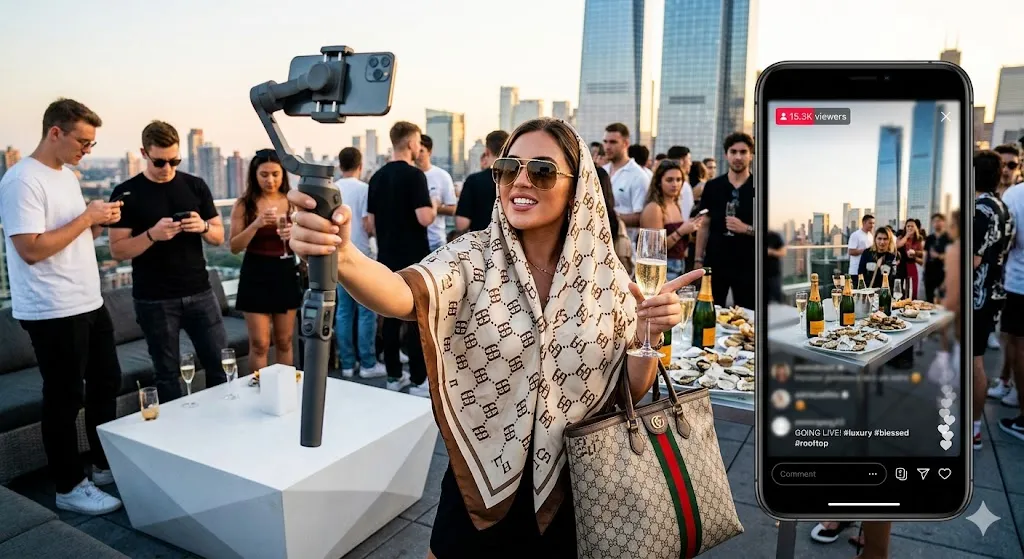
If status anxiety has always existed, social media has turbocharged it to an extraordinary degree. Platforms like Instagram, TikTok, and YouTube have created an environment where the performance of wealth is not just possible but algorithmically rewarded. The influencer flaunting a private jet (even a rented one), the lifestyle blogger cataloguing luxury hotel stays, the “rich kid” account showcasing designer hauls — all of these create a distorted reference class that makes ordinary middle-class life feel inadequate by comparison.
What is particularly insidious is that social media has made the performance of wealth accessible at a fraction of its historical cost. You do not need to actually be wealthy to look wealthy online. A rented Lamborghini for an afternoon photoshoot, a designer outfit borrowed for a single post, a hotel lobby that photographs like a private estate — the gap between appearance and reality has never been easier to manufacture or harder to detect.
The people most susceptible to this distortion are those in the aspirational middle — engaged enough with mainstream culture to see these displays, but not yet secure enough in their own financial identity to feel immune to them. The ultra-wealthy, ironically, tend to have very different relationships with social media. Many of the truly rich are private by necessity and inclination. Their status does not require Instagram validation.
The Old Money vs. New Money Divide
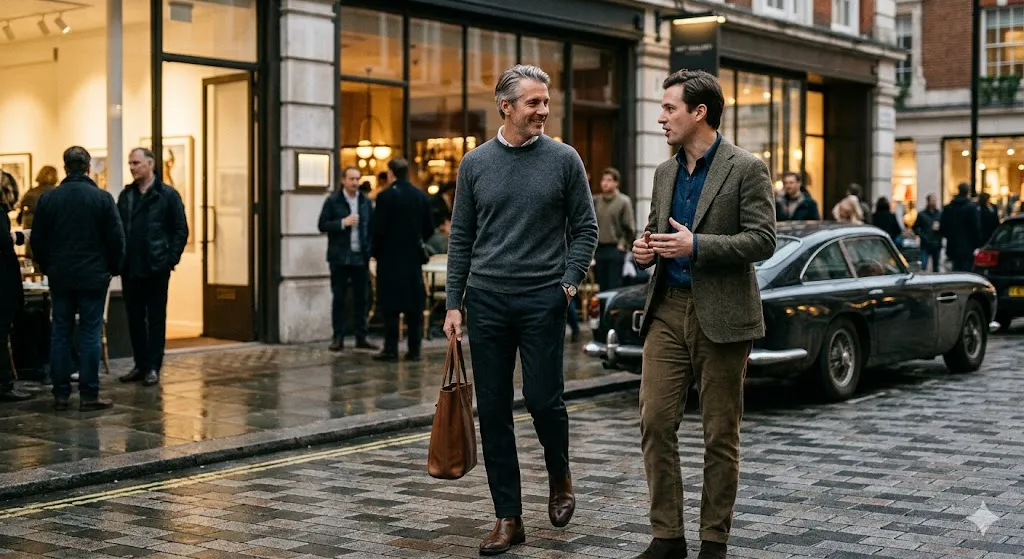
The distinction between old money and new money is one of the oldest class dynamics in modern societies, and it maps almost perfectly onto the pattern we are discussing. New money — wealth recently acquired — tends to be louder, more visible, and more invested in signaling. Old money — inherited wealth spanning multiple generations — tends toward discretion, understatement, and a cultivated indifference to display.
This is not coincidental. Old money families have so thoroughly internalized their status that it requires no external validation. Their identity does not depend on other people’s recognition of their wealth. They signal to each other through entirely different codes — the right school, the right sport, the right summer location, the right vocabulary — all of which are invisible to anyone outside the circle.
New money, by contrast, has not yet developed this settled confidence. The first generation to acquire significant wealth is still constructing a wealthy identity, and external signals are a crucial part of that construction. This is not a character flaw — it is a natural stage of wealth psychology. Many of the most ostentatious new-money displays eventually give way to discretion in the second or third generation, once the identity feels secure.
The Debt-Funded Illusion: When Looking Rich Makes You Poorer
There is a dark economic reality underlying much of this performative wealth. A significant portion of the visible affluence displayed by the middle class is not funded by surplus wealth — it is funded by debt. Auto loans for luxury vehicles, credit card balances for designer goods, mortgages stretched to the absolute limit in aspirational neighborhoods — the appearance of wealth is frequently constructed on a foundation of financial fragility.
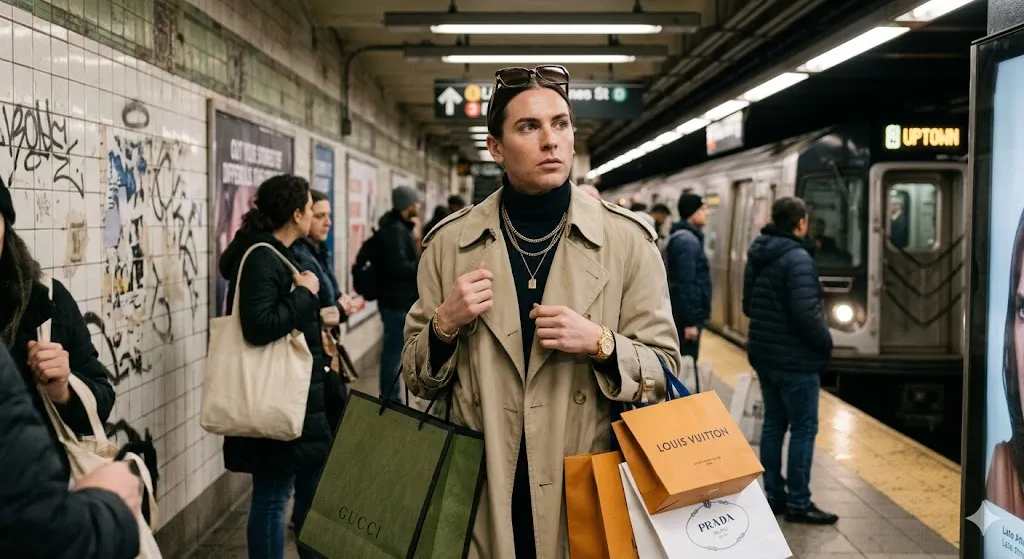
True wealth, as any competent financial advisor will attest, is the gap between what you earn and what you spend — the invisible surplus that accumulates quietly and compounds over time. Every dollar spent on a status symbol is a dollar not invested. The millionaire who drives a ten-year-old Toyota and lives in a house half the size his income could support is not being self-denying — he is simply prioritizing actual wealth over the performance of it.
The ratio of visible wealth to actual net worth in the aspirational middle class is strikingly inverted compared to the genuinely wealthy. Looking expensive and being wealthy are, more often than not, moving in opposite directions.
The Confidence Gap: Why Security Changes Everything
At its most fundamental level, the difference between the middle-class person performing wealth and the millionaire comfortable in their anonymity comes down to one thing: identity security. The question underneath all conspicuous consumption is this: Do I need other people to see me as successful in order to believe it myself?
When the answer is yes, spending on visible status becomes almost compulsive. The purchase does not satisfy for long because the underlying insecurity is not actually addressed by external validation — it only requires more of it. This is why status consumption becomes a treadmill rather than a destination.
When the answer is no — when a person’s sense of identity and worth is internally anchored rather than externally validated — the entire dynamic changes. A millionaire who has reached this point genuinely does not care whether strangers recognize his wealth. He wears the comfortable shoes not as an affectation but because they are genuinely the shoes he prefers.
People who have built wealth through deliberate saving and investing also tend to see money fundamentally differently. For them, a dollar spent on a depreciating status symbol is an opportunity cost measured in future growth. The $5,000 watch is also, to this mindset, the $50,000 that watch could become in twenty years. This shift in perspective — from money as something to display to money as something to deploy — is one of the clearest dividing lines between wealth performance and wealth accumulation.
What “Stealth Wealth” Reveals About True Confidence
In recent years, a cultural counter-movement has emerged called “stealth wealth” or “quiet luxury” — the preference for understated quality over branded ostentation. Cashmere without logos, tailoring without labels, quality materials in muted, classic palettes. This aesthetic has itself become trendy, which somewhat defeats the original point. But the genuine stealth wealth practiced by many high-net-worth individuals is not an aesthetic choice at all. It is a natural expression of security.
When you no longer need the logo to feel rich, you stop wearing the logo. When your identity does not depend on being recognized as wealthy by strangers, the recognizability of your possessions becomes irrelevant. You buy the better shoe, not the famous shoe. You stay at the quieter hotel, not the most photographed one. You drive the sensible car, not the one that announces itself first.
Breaking the Cycle
If status anxiety and identity insecurity are the roots of performative wealth, the antidote is not shame or austerity — it is a different kind of abundance: abundance of self-knowledge, of internal validation, of clarity about what money is actually for in your own life.
The people who break the middle-class wealth-signaling cycle tend to share a few characteristics. They have developed a personal definition of success that is not entirely dependent on external recognition. They understand the mathematics of compounding viscerally, not just intellectually. They have made peace with their origin story — whatever economic background they came from — in a way that does not require constant overwriting with status signals.
None of this happens automatically, and none of it is simply about willpower. It is about a fundamental shift in what money means and what it is for. And that shift, when it happens, tends to be quietly transformative — in ways that go far beyond personal finance.
The Bottom Line
The richest thing you can do is stop performing richness.
The millionaire in the grocery store checkout line, wearing an unbranded fleece and paying with a plain debit card, is not being ironic. He simply has nothing left to prove — and everything left to grow. The most powerful financial move is often the most invisible one: saving quietly, investing steadily, and resisting the seductive pull of a performance that costs everything and proves nothing.
The most expensive luxury of all is not the watch, the car, or the logo. It is the freedom not to care what you look like to strangers. And that freedom cannot be purchased. It can only be earned.
Frequently Asked Questions
Stealth wealth is the practice of keeping one’s high financial status private or unnoticeable. In fashion, this translates to “quiet luxury”—wearing incredibly expensive, high-quality clothing that lacks prominent brand logos, flashy designs, or obvious indicators of wealth.
Ultra-wealthy individuals often dress simply for a few key reasons:
Status signaling: They don’t feel the need to prove their wealth to the public; their status is already recognized within their elite social circles.
Cognitive fatigue: Simplifying their wardrobe (like Steve Jobs’ iconic turtleneck) saves mental energy for high-stakes decision-making.
Understated quality: While a garment looks simple, it is often custom-tailored from premium materials like cashmere or silk, prioritizing comfort and longevity over flashiness.
For many middle-class consumers, highly visible luxury brands serve as a tool for aspirational signaling. Buying items with prominent logos is a way to project a higher social and financial status than they actually possess, associating themselves with success, exclusivity, and prestige.
Coined by sociologist Thorstein Veblen, conspicuous consumption is the practice of buying and displaying expensive goods and services specifically to publicly demonstrate wealth and social status, rather than for the intrinsic utility of the items themselves.
Many self-made millionaires avoid flashy lifestyles to maintain financial security and privacy. According to research (like The Millionaire Next Door), true wealth accumulation often requires frugality. Avoiding flashy luxury items prevents target-hardening against scams or lawsuits, minimizes unwanted public attention, and ensures that capital is reinvested into wealth-building assets rather than depreciating luxury goods.