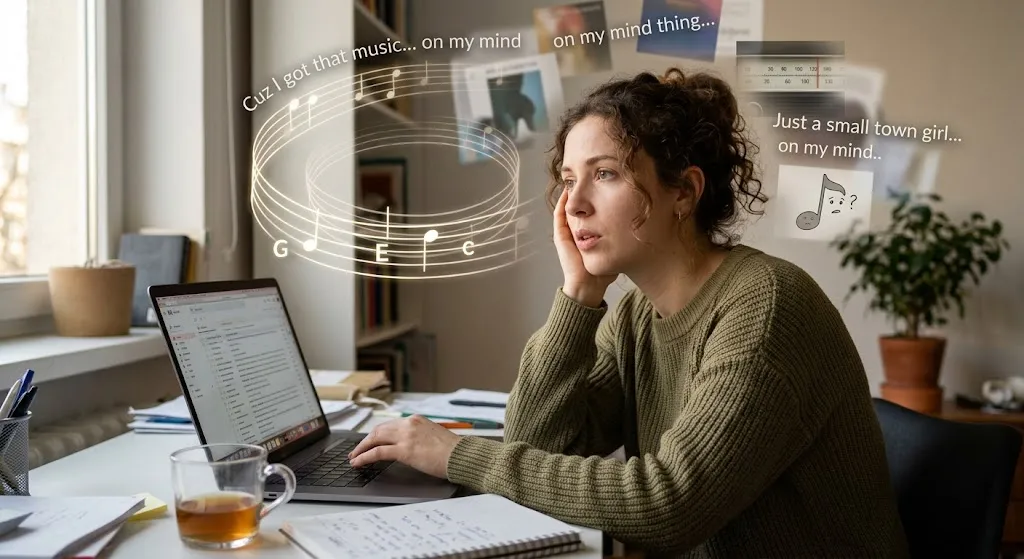
You hear three notes of a song in a grocery store. You don’t even like the song. You haven’t thought about it in years. And now it’s 4 p.m., you’re trying to answer emails, and some part of your brain is quietly, relentlessly looping the chorus like it’s being paid to do it.
This is one of those experiences that feels oddly personal and embarrassing when it’s happening — like your brain has developed a mind of its own and picked the worst possible moment to misbehave — but it turns out to be almost universally shared. Scientists have a name for it, a surprising number of formal theories about why it happens, and, mercifully, a few evidence-backed ways to make it stop.
First, You’re Not Alone — Not Even Close
Before getting into the mechanics, it’s worth sitting with just how common this is. Researcher James Kellaris, a marketing professor at the University of Cincinnati who’s become something of the field’s go-to expert, found that 98 percent of people report experiencing this phenomenon. A separate large-scale study of over 12,000 people in Finland found that 91.7 percent reported getting a song stuck in their head at least once a week.
So if you’ve ever felt a little unhinged standing in your kitchen humming a jingle you haven’t heard since childhood, take some comfort: you’re in the company of nearly everyone who has ever owned a pair of ears.
The Official Name Is Less Fun Than “Earworm”
The catchy term “earworm” comes from a direct translation of the German word Ohrwurm, and it’s the name that stuck in popular use, but scientists tend to use a more clinical label: involuntary musical imagery, or INMI. It refers to a spontaneous, repetitive musical experience that occurs without any deliberate effort to bring it on and, often, despite active effort to make it stop.
INMI sits in a broader category researchers call self-generated thought — the same general bucket that includes daydreaming and mind-wandering. That’s a meaningful clue about what’s actually happening: an earworm isn’t some rogue neurological glitch happening to you. It’s your brain’s normal, everyday tendency to wander and self-generate content, just with a melody providing the material instead of a worry or a memory.
What Makes a Song “Sticky”
Not every song has equal earworm potential. Some tunes seem almost engineered to burrow in, while others you can hear a dozen times and never think about again. Kellaris’s research identified a few consistent features shared by the songs most likely to get stuck:
Repetition. A short, repeating musical phrase is easy for the brain to “finish” once it starts — which means it’s just as easy to restart. Once a loop begins, there’s very little friction stopping it from looping again.
Simplicity. Simple, predictable melodic structures are stickier than complex ones. This is part of why children’s songs, jingles, and pop hooks are disproportionately represented among classic earworms — they’re built for exactly this kind of easy mental replay.
A small twist. Interestingly, pure simplicity alone isn’t quite enough — Kellaris found that the catchiest tunes tend to contain some mild melodic incongruity, a tiny surprise or deviation from the expected pattern. It’s the combination of “mostly predictable” plus “one small surprise” that seems to make a song maximally memorable, not predictability by itself.
Lyrics. Songs with words get stuck far more often than instrumental music. Kellaris’s data found that music with lyrics accounted for the vast majority of earworm cases, while purely instrumental pieces made up only a small fraction. Words appear to give the brain an additional anchor — a verbal hook to loop alongside the melodic one.
The “Brain Itch” Theory
One of the more vivid explanations for why earworms feel so compulsively repetitive is what’s sometimes called the “cognitive itch” theory, closely associated with Kellaris’s work. The idea is that certain musical patterns create a kind of low-level irritation in auditory processing — not unlike a physical itch — and the brain’s instinctive response is to “scratch” it by mentally replaying the tune.
The trouble, much like an actual itch, is that scratching tends to make things worse rather than better. Each mental replay reinforces the loop instead of resolving it, which is part of why earworms can feel like they’re feeding themselves the more attention you give them.
Your Auditory Cortex Doesn’t Like Loose Ends
There’s also a more concrete neurological piece to this. Hearing a piece of music activates the auditory cortex, and research has shown that this region doesn’t just process sound passively — when people hear part of a familiar song, their auditory cortex tends to automatically fill in the rest of the phrase or melody, even continuing to “play” it internally after the actual sound has stopped.
This helps explain a specific, very recognizable version of the earworm experience: getting stuck not on an entire song, but on a single fragment — usually because you can’t quite recall how the next part goes. Your brain, having started the pattern, keeps circling back to complete it, replaying the same segment over and over as it tries and fails to bridge the gap.
What Actually Triggers One
Earworms don’t usually arrive from nowhere. Researchers studying triggers have generally converged on a handful of common causes:
- Recent exposure. Simply having heard a song recently — even in the background, even without paying attention — makes it a strong candidate to resurface uninvited later.
- Associative triggers. A place, a person, a smell, or even a specific word can act as a cue that pulls a linked song back into conscious awareness, the same way a familiar street corner might trigger an unrelated memory.
- Emotional state. Hearing music during a moment of heightened emotion — whether stress, excitement, or grief — appears to make that music more likely to loop back later, possibly because emotional arousal strengthens memory encoding generally.
- Low attention and idle moments. Earworms are especially prone to show up during quiet, understimulated stretches of the day — the shower, a commute, a boring task — precisely the conditions where the mind tends to wander in general.
It’s also worth noting that frequent, regular music listeners tend to experience earworms more often, simply as a function of exposure. More music in, more raw material available for your brain to loop back on later.
Is There Any Actual Cure?
Here’s the honest answer: there’s no scientifically confirmed, universal fix, largely because earworms are notoriously difficult to study — they arrive unpredictably and can’t easily be triggered on demand in a lab setting. But a few strategies have decent evidence and a lot of anecdotal support behind them:
- Engage a different part of your working memory. Activities that require verbal or numerical focus — a crossword, a sudoku, mental math — seem to compete with the mental “space” an earworm needs to keep looping, crowding it out rather than fighting it head-on.
- Finish the song. If your earworm is stuck on an incomplete fragment, actually listening to the whole song, start to finish, can sometimes resolve the loop simply by giving your auditory cortex the ending it’s been trying to reconstruct.
- Chew gum. This sounds almost too simple to be real, but some research has pointed to jaw movement interfering with the subvocal rehearsal that seems to underlie a lot of musical replay — the same general mechanism thought to be involved in verbal working memory.
- Just wait it out. Most earworms are self-limiting. Left alone, without active irritation or attempts to suppress them (which tend to backfire, the way trying not to think about something usually does), the majority fade within about a day.
The Weirdly Reassuring Part
If there’s a comforting takeaway buried in all of this, it’s that an earworm isn’t a malfunction. It’s a fairly ordinary side effect of a brain that’s extremely good at pattern recognition, prediction, and memory consolidation — the same machinery that lets you recognize a friend’s voice instantly or finish a familiar sentence someone else started. Music, with its built-in structure of repetition, expectation, and small surprise, happens to be almost perfectly shaped to exploit that machinery.
So next time you catch yourself humming the same eight seconds of a song for the fortieth time in an hour, you can skip the self-diagnosis. It’s not a sign anything’s wrong with you. It’s just your very ordinary, very human brain, doing the thing it’s built to do — a little too enthusiastically, for a little too long.
Conclusion
At the end of the day, an earworm is proof of something oddly wonderful: your brain is exceptionally good at holding onto pattern, rhythm, and emotion, even when you’d rather it didn’t. The same wiring that lets a song move you, comfort you, or transport you straight back to a specific summer of your life is the wiring responsible for trapping a jingle in your head for six hours straight. It’s an inconvenient side effect of a genuinely remarkable system.
So the next time a song hijacks your afternoon, you don’t need to fight it like an enemy or worry it means something’s off with your focus or your mind. Let it run its course, give your brain something else to chew on if it’s really overstaying its welcome, and trust that — like almost every earworm before it — it will loosen its grip in due time. In the meantime, you’re simply experiencing one of the most universal, well-documented quirks of being a person with ears and a memory.
Sources & Further Reading
- James Kellaris, University of Cincinnati — foundational research establishing that the vast majority of people experience involuntary musical imagery, and identifying the “cognitive itch” theory along with the musical features (repetition, simplicity, melodic incongruity, lyrics) that make certain songs especially sticky
https://www.thestar.com.my (search: “James Kellaris earworm cognitive itch research”) — or search Kellaris’s published work via University of Cincinnati’s faculty page - Lassi A. Liikkanen — large-scale survey research (approx. 12,000 respondents in Finland) on how frequently people experience earworms and what tends to trigger them
Published research available via Applied Cognitive Psychology and Liikkanen’s INMI research resource page - Oliver Sacks — proposed “involuntary musical imagery” as a more clinical alternative term to “earworm,” and wrote about musical hallucination and the brain’s relationship to music more broadly in Musicophilia
https://www.oliversacks.com - Dartmouth College — auditory cortex research demonstrating that the brain automatically completes familiar musical phrases from partial or incomplete cues